

Nicotinamide and Skin Cancer Risk: What Studies Show
At Suncoast Skin Solutions, we follow the research closely so we can offer patients practical options supported by clinical evidence. One approach that has generated substantial academic interest is oral nicotinamide for reducing the risk of new basal cell and squamous cell carcinomas in higher-risk patients. Here’s what the studies show.
How Nicotinamide May Help the Skin
Nicotinamide (a form of vitamin B3) helps replenish cellular NAD+ levels, which can be depleted by UV exposure. It supports DNA repair and may reduce UV-induced immunosuppression in the skin. The most influential evidence comes from high-risk populations, especially people who have already had basal or squamous cell carcinoma.
Nicotinamide is not a substitute for sun protection, regular skin exams, or treatment of existing lesions. It is also not indicated for everyone. The findings below come from a large randomized trial and a large Veterans Affairs cohort, and they are most relevant to people with a prior history of these skin cancers.
The ONTRAC Trial
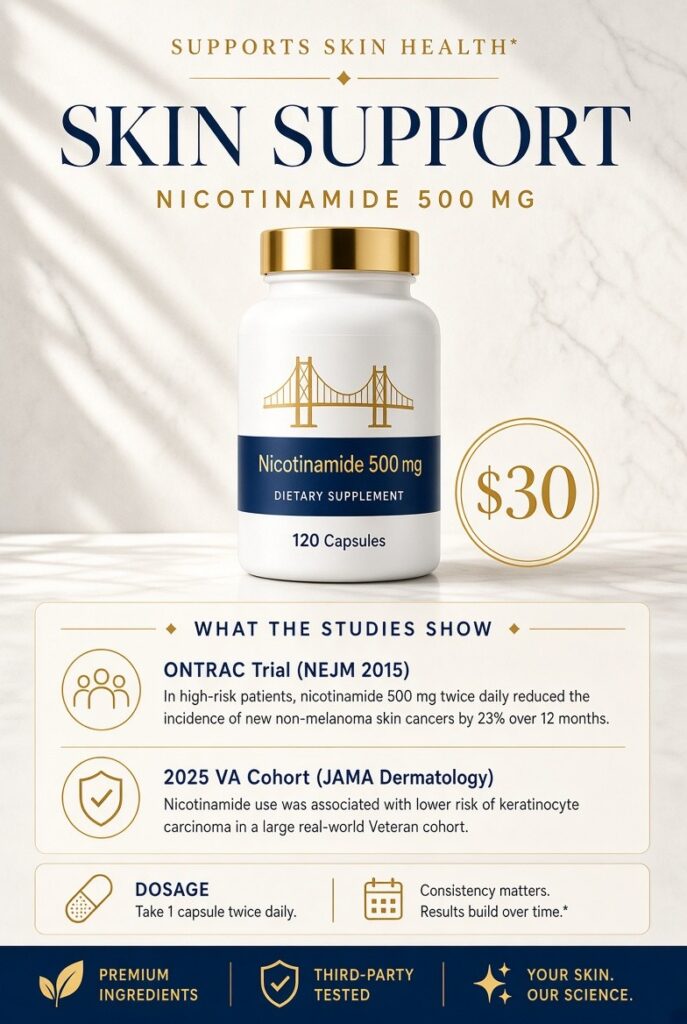
The landmark phase 3 ONTRAC trial (Chen et al., New England Journal of Medicine, 2015) randomly assigned 386 patients who had already had at least two non-melanoma skin cancers in the prior five years to 500 mg of nicotinamide twice daily or placebo for 12 months. Dermatologists evaluated participants at three-month intervals for 18 months, covering the year of treatment and a six-month period after the supplement was stopped.
The nicotinamide group had a 23% lower rate of new non-melanoma skin cancers overall (basal cell and squamous cell carcinomas combined). Squamous cell carcinomas were reduced by about 30% and basal cell carcinomas by about 20%. Actinic keratoses were also lower: 11% lower at three months, 14% lower at six months, 20% lower at nine months, and 13% lower at 12 months. The treatment was well tolerated, with no meaningful increase in adverse events. Benefits largely stopped after the supplement was discontinued.
The 2025 Veterans Affairs Study
A large retrospective cohort study using Veterans Affairs data (Breglio et al., JAMA Dermatology, 2025) examined 33,822 patients. Researchers compared 12,287 people who took nicotinamide 500 mg twice daily for more than 30 days with 21,479 matched patients who were not exposed to that regimen.
Those who took nicotinamide showed an overall 14% reduction in subsequent skin cancers compared with the matched unexposed group. The reduction was greater when nicotinamide was started after a first skin cancer (54% in that analysis) and was particularly notable for cutaneous squamous cell carcinoma. Benefit appeared strongest with earlier initiation after an initial cancer and declined when nicotinamide was started after later, subsequent skin cancers.
Among solid organ transplant recipients in the same study, no overall significant risk reduction was observed, although early nicotinamide use was associated with reduced cutaneous squamous cell carcinoma. This is one reason nicotinamide is not a one-size-fits-all option and should be discussed with a dermatologist who knows your medical history.
Together, these studies indicate that oral nicotinamide at 500 mg twice daily can reduce the number of new basal and squamous cell carcinomas in people with a prior history of these cancers. It is not a substitute for sun protection, regular skin exams, or treatment of existing lesions, including Mohs surgery when it is recommended, and it is not indicated for everyone.
Skin Support Nicotinamide 500 mg
Skin Support Nicotinamide 500 mg (120 capsules) matches the dose used in the major trials: one capsule twice daily. It is formulated to support skin health after everyday UV exposure. Coming soon to Suncoast Skin Solutions locations. Ask your local office about availability.
These statements have not been evaluated by the Food and Drug Administration. This product is not intended to diagnose, treat, cure, or prevent any disease.
Practical Takeaways
Consistent sun protection remains the foundation of skin-cancer risk reduction. For patients with a history of basal or squamous cell carcinoma, discussing nicotinamide with your dermatologist is reasonable based on the available evidence.
Results from any approach are individual. Always consult your Suncoast Skin Solutions provider before starting a new supplement, especially if you have a history of skin cancer, take other medications, or have other medical conditions. We are happy to review whether this option fits your medical history.
Schedule a visit at one of our 40+ Florida locations to discuss personalized recommendations.
Frequently Asked Questions
Who may want to discuss nicotinamide with a dermatologist?
The strongest evidence is in people who already have a history of basal cell or squamous cell carcinoma. The ONTRAC trial enrolled patients who had at least two non-melanoma skin cancers in the prior five years. The later Veterans Affairs study also found a larger reduction when nicotinamide was started after a first skin cancer. Nicotinamide is not indicated for everyone. Talk with your Suncoast Skin Solutions provider before starting it.
What dose of nicotinamide was used in the major studies?
Both the ONTRAC trial and the 2025 Veterans Affairs cohort used nicotinamide 500 mg twice daily. Skin Support Nicotinamide 500 mg is dosed as one capsule twice daily to match that regimen. Ask your provider whether this option is appropriate for you.
Does nicotinamide replace sun protection or treatment of existing skin cancers?
No. It is not a substitute for sun protection, regular skin exams, or treatment of existing lesions, including Mohs surgery when it is recommended. Existing cancers still need to be evaluated and treated.
What happens if nicotinamide is stopped?
In the ONTRAC trial, benefits largely stopped after the supplement was discontinued. There was no evidence of benefit in the six months after treatment ended. Any plan to start or stop nicotinamide should be made with your dermatologist.
References
- Chen AC, Martin AJ, Choy B, et al. A Phase 3 Randomized Trial of Nicotinamide for Skin-Cancer Chemoprevention. N Engl J Med. 2015;373(17):1618-1626. PMID 26488693. https://pubmed.ncbi.nlm.nih.gov/26488693/
- Breglio KF, Knox KM, Hwang J, et al. Nicotinamide for Skin Cancer Chemoprevention. JAMA Dermatol. 2025;161(11):1140-1147. PMID 40960808. https://pubmed.ncbi.nlm.nih.gov/40960808/