

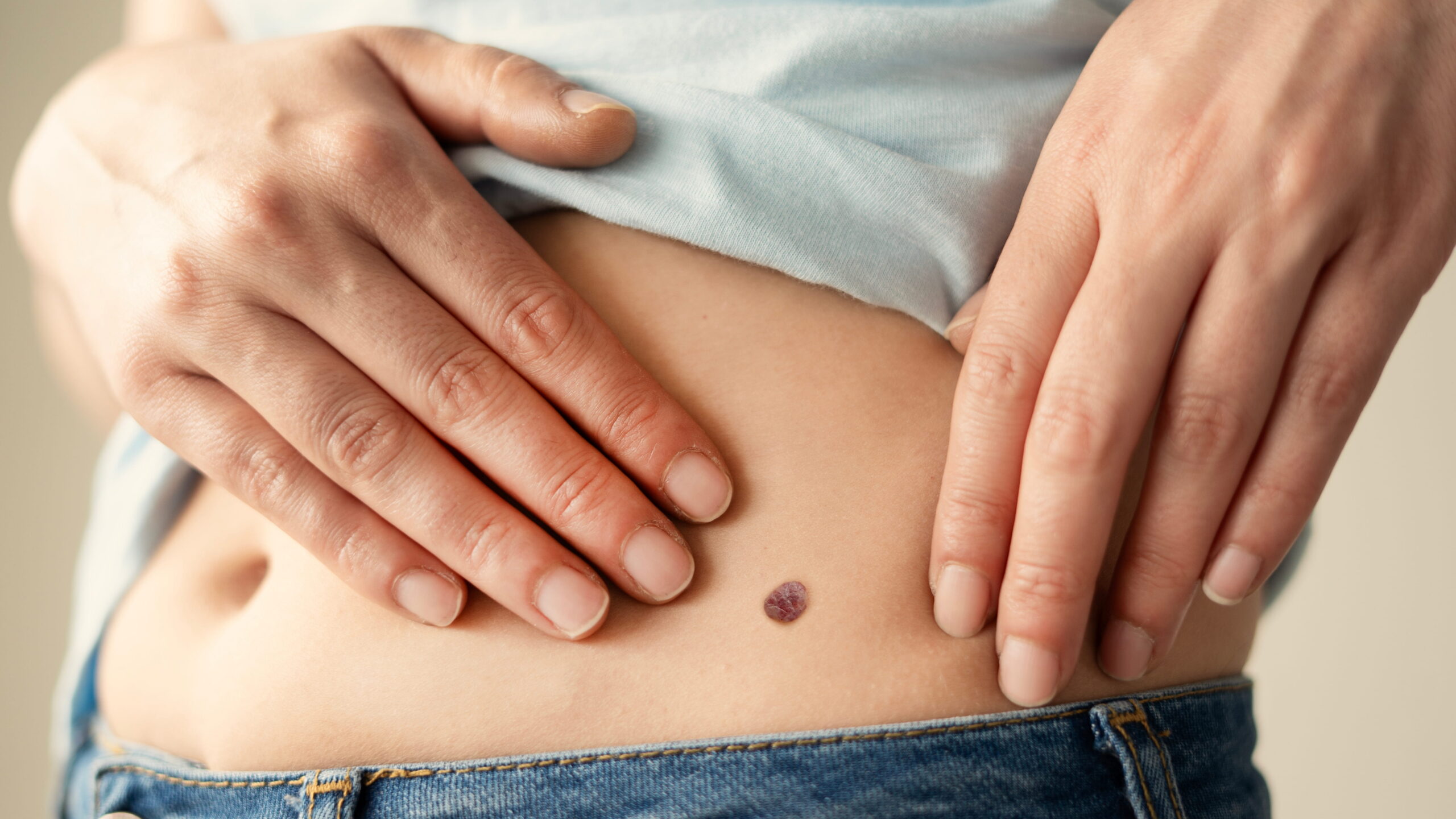
Performing a regular skin cancer self-exam can save lives. At Suncoast Skin Solutions, we know early detection is one of the best ways to keep skin cancer from becoming life-threatening. Statistics show that one in five Americans will develop skin cancer by age 70. When melanoma is found early and has not spread to the lymph nodes, the five-year survival rate is 99%.
We often see that patients who check their skin regularly find melanoma at its earliest, most treatable stage. That can lead to better outcomes. This guide walks you through how to examine your skin, which warning signs to watch for, and when to see a dermatologist. In Florida, where UV exposure happens year-round, monthly self-exams matter even more.
Why Skin Self-Exams Matter and How Often to Do Them
Monthly skin self-exams are an important part of skin cancer prevention. They help you notice new growths, monitor existing moles, and spot changes between dermatology visits.
The Skin Cancer Foundation recommends checking your skin once a month. A consistent routine helps you learn what is normal for your skin, so changes are easier to notice. A self-exam should become a simple habit, like checking the oil in your car.
Some risk factors make these exams especially important. These include fair skin that burns easily, a history of severe sunburns, frequent UV exposure from the sun or tanning beds, having more than 50 moles, a family history of skin cancer, and a weakened immune system. Even so, regular self-checks help everyone, regardless of skin type or risk level.
How to Check for Skin Cancer at Home: Monthly Skin Self-Exam
A thorough skin exam takes a little time and a careful eye. Before you begin, you should gather a full-length mirror, a hand mirror, bright lighting, a comb or blow dryer for the scalp, and a camera or smartphone to document anything you want to watch.
Step 1: Front and Back
Start by standing in front of a mirror and checking your entire front, including the face, neck, and torso. Then use a hand mirror to examine your back, buttocks, and shoulders.
Step 2: Arms, Hands, and Underarms
Raise your arms and inspect the undersides. Then check both sides of your forearms and upper arms, along with your palms and the spaces between your fingers. You should remove your nail polish so you can examine the nail beds carefully. Melanoma can form under the nails.
Step 3: Face, Ears, and Neck
Move close to the mirror and check the entire face, including the nose, lips, mouth, and ears, from both the front and the back.
Step 4: Scalp
Use a comb to part the hair in sections and inspect the scalp piece by piece. Areas where the hair naturally parts deserve special attention.
Step 5: Lower Body
Sit down and examine the front and back of your legs. Also check between the toes, the soles of the feet, the toenails, and the heels. If needed, remove toenail polish.
Step 6: Track and Document
Take photos of anything you want to monitor and note the date and location of each spot. This record helps you monitor changes and provides your dermatologist with useful information later.
The ABCDE Melanoma Signs: What to Look For
The ABCDE guideline helps you spot signs of melanoma and other early signs of skin cancer that need professional evaluation.
Asymmetry
You draw an imaginary line through the middle of a mole. If the two halves do not match in size, shape, or thickness, that may be a warning sign. Benign (or noncancerous) moles usually look symmetrical.
Border Irregularity
Benign moles tend to have smooth, even borders. Melanoma may have irregular, notched, scalloped, or blurred borders.
Color Variation
A healthy mole usually has a single, consistent color, such as tan, brown, or black. Watch for multiple shades of brown, black, red, white, or blue in the same spot. A mix of colors should be checked.
Diameter
Melanomas are often larger than 6 millimeters, about the size of a pencil eraser. They can also be smaller when they first appear. Any mole that is growing deserves attention.
Evolution
This is one of the most important warning signs. Any change in size, shape, color, or elevation should be evaluated. Watch for new symptoms such as bleeding, itching, or crusting.
The “ugly duckling” sign can also help. If one mole looks different from the others on your body, whether darker, lighter, larger, or simply unusual, you should have it checked.
What Does Skin Cancer Look Like?
So, what does skin cancer look like? Different types can look very different. And unlike freckles, which are flat, uniform, and stable, cancerous lesions change in appearance over time. Knowing the differences can help you tell lesions from harmless skin changes.
Basal Cell Carcinoma
This is the most common type of skin cancer. About eight out of 10 skin cancers are basal cell carcinomas. It often appears as pearly or waxy bumps, flat flesh-colored or brown scar-like spots, or sores that bleed, heal, and return. These growths often show up on sun-exposed areas such as the head, neck, and arms.
Squamous Cell Carcinoma
Squamous cell carcinoma may appear as firm red nodules or flat lesions with scaly, crusted surfaces. It often develops in actinic keratoses, long-standing sores, or areas of prior injury.
Melanoma
Melanoma can look very different from one person to another. It may appear as a dark, irregular mole, but it can also be pink, red, purple, or skin-colored. Under the nails, it may show up as a dark streak that can be mistaken for a bruise.
Any skin change that lasts more than four weeks should be evaluated.
General Warning Signs:
- A sore that does not heal
- A persistent scaly or red patch
- A new firm or pearly growth
- A spot that looks different from the rest
When to Call a Dermatologist
Some findings during a self-exam call for prompt medical attention. You should schedule an appointment right away if you find a lesion that meets ABCDE criteria, a new growth after age 30, a change in an existing mole, a sore that does not heal within four weeks, or any spot that bleeds, itches, or becomes tender without an obvious cause.
Dermatologists have the training and tools to evaluate suspicious spots more accurately. It’s also a good idea to establish care with a board-certified dermatologist for regular full-body exams. These visits help check hard-to-see areas and work alongside your self-exams. Most adults should have a yearly full-body skin exam, while higher-risk patients may need visits every six months.
Early detection makes a real difference. Regular skin cancer self-exam habits, along with professional screenings and daily sun protection, give you a strong defense against skin cancer. Spending about 15 minutes each month on self-exams can support early detection and treatment. To schedule a professional exam, contact Suncoast Skin Solutions for expert evaluation and care.
Frequently Asked Questions
What does skin cancer look like?
You use the ABCDE of melanoma warning signs and the “ugly duckling” rule. Any spot that is asymmetric, has irregular borders, shows multiple colors, is larger than 6 mm, or changes over time should be evaluated.
Can skin cancer appear in places that don’t get sun?
Yes. Melanoma can appear on the palms, soles, under the nails, in the genital area, and in the mouth. Basal cell carcinoma and squamous cell carcinoma are more common on sun-exposed skin.
How to check moles for cancer when I can’t see them, like on my back or scalp?
You can use a hand mirror, a full-length mirror, ask a partner for help, or part the hair with a comb to see the scalp. Professional skin exams also help find spots you might miss.
What should I do if I find a suspicious spot?
You should schedule an appointment with a board-certified dermatologist as soon as possible. Taking a dated photo can help show how the spot looked when you first noticed it. Suncoast Skin Solutions offers same-day appointments at most Florida locations.
How often should I get a professional skin cancer screening?
Most adults should have a full-body skin exam once a year. Higher-risk patients may need exams every six months. Self-exams are helpful, but they do not replace professional screening.