

How Often Should You Get a Skin Cancer Screening?
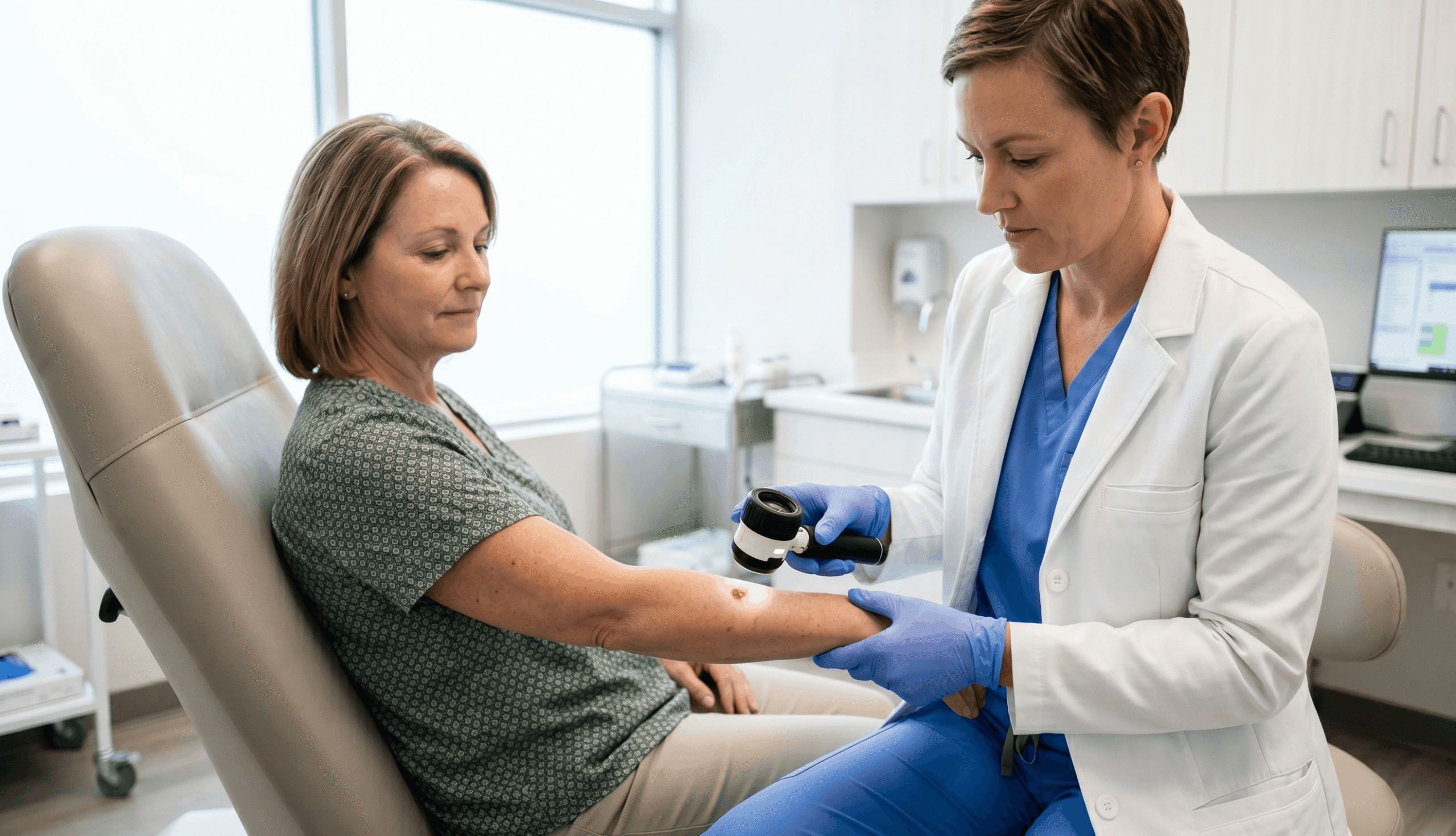
Skin cancer is the most common cancer in the United States. It is also highly treatable when caught early. That is why our team at Suncoast Skin Solutions encourages people to get screened for skin cancer before they notice a problem.
A skin cancer screening takes less time than a lunch break. It is quick, painless, and non-invasive. For many adults, screening frequency depends on individual risk, and higher-risk patients are often seen annually or more often. Some higher-risk patients may need visits every six months or as directed by their dermatologist. In Florida, where UV exposure is part of daily life all year, staying on schedule is a smart choice.
What Is a Skin Cancer Screening? (And What to Expect)
A full-body skin cancer screening is a head-to-toe skin exam performed by a board-certified dermatologist. During a full-body screening, we examine the scalp, face, neck, trunk, arms, legs, feet, and nails.
We often use a dermatoscope, a handheld device that helps us see details beneath the skin’s surface. It allows us to evaluate pigment patterns, blood vessels, and structural features that are not visible to the naked eye.
Most appointments take 15 to 30 minutes. You will either change into a gown or remain in your undergarments while we carefully examine your skin. If we see something concerning, we may recommend a biopsy that day or at a follow-up visit.
How Often Should You Get a Screening?
There is no single schedule that fits everyone. That is why a dermatology visit matters. Professional guidance varies, but regular self-checks and skin exams are widely encouraged, especially for patients at higher risk.
For healthy adults with no concerning history, we usually recommend a yearly skin exam. Some patients need more frequent visits. Others may do well with less frequent screening. The right schedule depends on your history, your skin type, and your exposure to risk factors.
Early detection gives us the best chance to treat skin cancer effectively. A yearly screening is one of the simplest steps you can take to protect your health.
Skin Cancer Screening Frequency Based on Risk Factors
Skin cancer risk factors vary by patient, and your screening schedule should reflect that.
Average Risk: Every 1 to 2 years
You have no personal or family history of skin cancer, a few moles, skin that tans more easily than it burns, and limited sun exposure over time. An annual or every-other-year screening may be appropriate.
Moderate Risk: Annually
You burn easily or have fair skin, light eyes, or light hair. You may have more than 50 moles, a history of serious sunburns, significant sun exposure, or a first-degree relative with melanoma or another skin cancer. For this group, yearly skin exams are the standard approach.
High Risk: Every 6 months or as directed
You have a personal history of melanoma, basal cell carcinoma, or squamous cell carcinoma. You may have a genetic predisposition, such as a CDKN2A mutation or familial atypical mole syndrome. You may also be immunosuppressed because of medication, an organ transplant, or another condition. Patients with more than 100 moles, atypical moles, or a history of radiation therapy may also need closer monitoring.
Keep in mind, too, that risk factors can build over time. A 55-year-old with fair skin, decades of Florida sun exposure, and a family history of melanoma is not the same as a 30-year-old with no major risk factors. We look at the full picture and recommend a schedule that fits your needs.
Why Skin Cancer Screening Is Important in Florida
In Florida, year-round UV exposure is a fact of life. We spend a lot of time outdoors and often carry the effects of decades in the sun. Unlike colder states, Florida gets less seasonal relief, and UV exposure remains a year-round concern. Golf, fishing, beach days, and daily routines all take their toll. And since UVA rays pass through clouds and glass, exposure continues even when skies are gray, or you’re behind the wheel.
That slow, steady damage is easy to miss, making early detection of skin cancer harder. Regular skin cancer screenings give us a chance to find changes early, when treatment is usually simpler and more effective.
Dermatologist Skin Cancer Screening vs. Self-Exams
Both are important, and they serve different purposes. Monthly self-exams help you notice new spots or changes between visits. We recommend checking your skin in good lighting with a full-length mirror and a hand mirror for hard-to-see areas. The American Academy of Dermatology uses the ABCDE warning signs: asymmetry, border irregularity, color variation, diameter larger than 6 mm, and evolution over time.
Self-exams have limits, though. You cannot see your scalp well. You may miss the back of your neck, the space between your shoulder blades, or the bottoms of your feet. Even when you can see a spot, you do not have the tools or training to evaluate it the way a dermatologist can.
That is where a professional screening matters. A dermatologist can catch changes that patients often miss. Self-exams and regular screenings work best together.
Skin Cancer Screening Cost and Insurance Considerations
Skin cancer screening costs are a common consideration. How much a screening costs, however, depends on your insurance provider, your location, and your insurance plan.
Preventive screenings may be covered or billed differently depending on how the visit is coded. If we find a suspicious lesion and perform a biopsy, the visit may shift from preventive to diagnostic care, which can affect cost-sharing. Medicare and many private insurance plans cover dermatology visits, but details vary.
We recommend calling your insurance company before your appointment. Ask whether a skin exam or full-body skin cancer screening is covered, and confirm your copay or deductible. Our team at Suncoast can also help you understand what to expect before your visit. Cost should never be the reason someone delays care.
Frequently Asked Questions
How often should I get a skin cancer screening if I have no risk factors?
For average-risk adults with no personal or family history of skin cancer, many dermatologists recommend screening every one to two years. In Florida, an annual exam is a wise choice for most adults.
Does insurance cover skin cancer screening?
It depends on your plan and how the visit is coded. Some plans cover an annual skin exam as preventive care. Others treat them as specialist visits and apply your deductible. We encourage patients to check their benefits before scheduling.
What happens during a full-body skin cancer screening?
You will change into a gown, and we will examine your skin from scalp to sole. The visit usually takes 15 to 30 minutes. We may use dermoscopy on spots that need a closer look. If we see anything concerning, we will explain the next steps before you leave.
Don’t Wait for Something to Look Wrong
Skin cancer screening is most valuable before there is a reason to worry. Early detection, especially for melanoma, improves outcomes and can reduce the need for more involved treatment. For most adults, yearly exams are the standard. In Florida, where UV exposure is part of everyday life, staying proactive matters.
If it has been more than a year since your last skin exam, or if you have never had one, now is a good time to schedule. Book a skin cancer screening with a Suncoast dermatologist, or find the location nearest you.